
TL;DR
- Question: can a Chrome extension tell you which LinkedIn posts were written by AI, without ever accusing a real person?
- Result: it labels every post in the feed as you scroll. On my test set, Claude Sonnet, which does the labelling, called 0 of 355 human texts “Likely AI” and caught 39% of 160 AI texts.
- How: free checks in the browser first, then Claude reads each post of 30 words or more and explains its call; only Claude may say “Likely AI”.
- My take: use it as a hint, never as proof. It misses more than half the AI text, and every AI rewrite of real people’s writing in my test.
My LinkedIn feed is full of posts that read like they were written by AI, and I wanted to know which ones really were. My impression of the detectors I’d read about is that they give a confident percentage and flag real people too often, which is the worst mistake a tool like this can make. So I set myself one rule before anything else: it may miss AI, but it must never accuse a human. The question was how much it could still catch under that rule.
The demo above is a made-up feed, labelled the way the extension labels linkedin.com. Click a label to see Claude’s reasons, paste a post of your own into “Try your own text”, or press “Download for Chrome” to install the extension.
#Labels on every LinkedIn post
With the extension on, every post LinkedIn loads gets a label in its top-right corner, next to the “…” button: Likely AI, Uncertain or Likely human with Claude’s score, or “Too short to judge” for posts under 30 words. Click a label and a card opens with Claude’s reasons. The popup has one On/Off button.
- Every post, in order: the free checks run on each post as soon as LinkedIn loads it. Then Claude Sonnet 5.5 checks the posts of 30 words or more one at a time, from the top of the feed down.
- The whole post: LinkedIn folds long posts behind “…more”, but the full text is already in the page, so Claude reads all of it. On a post that showed 3 lines, it got all 180 words.
- Limits: at most 40 Claude checks an hour, and a post is never sent twice: its result is kept in the browser for 7 days.
- Cost: one check of a typical 150-word post cost $0.004 on the API in my test on 16 November 2026.
When the 40 checks of an hour are used up, the remaining posts get the free checks’ label (Uncertain or Likely human, never Likely AI), marked “Claude paused for this hour”, and Claude carries on once the hour allows.
On my own feed on 18 November 2026, all 20 posts that loaded got a label: 1 Likely AI, 12 Uncertain, 2 Likely human and 5 Too short to judge, and no check failed.
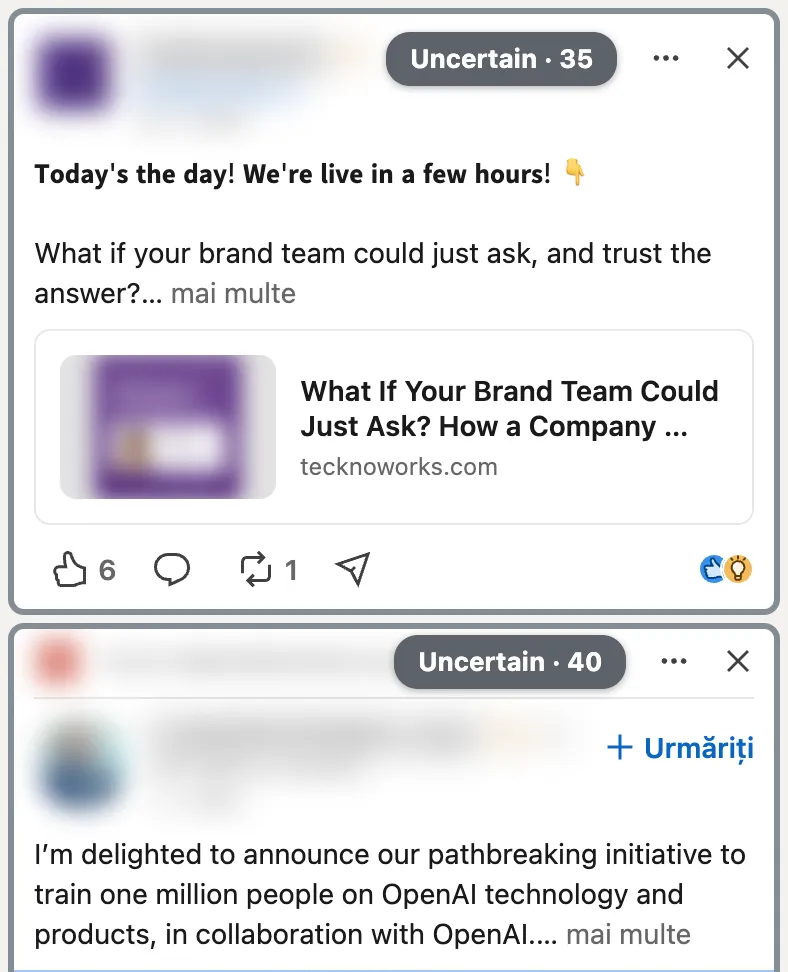
An earlier pass that morning had 2 posts come back “Claude failed”: Sonnet had written its reasoning before its answer, which the extension refuses on purpose, so that a page can’t slip a fake answer into the text. The server now has the API hold Claude to the answer’s shape. That fixed it, but it also moved the scores, so I measured again (below).
Claude runs on a small X2 Labs server that holds the lab’s API key, so the extension needs no key and no setup. The server sends Claude only the post’s text and stores nothing. It isn’t on the Chrome Web Store, and Chrome doesn’t let a website install an extension, so installing takes three clicks: unzip the download, turn on Developer mode in chrome://extensions, and choose “Load unpacked”.
#Three checks, one verdict
The same checks work anywhere: highlight text, right-click and pick “Check for AI”. A card opens next to the text with one of four answers: Likely AI, Uncertain, Likely human or Too short to judge, plus the reasons behind it.
The extension stacks several checks:
- Fingerprints: traces only AI tools leave, such as a
utm_source=chatgpt.comlink, leftover citation markers or “As an AI language model”. - Writing style: sentence-length variety, words AI overuses, em-dashes, and casual signs like slang that point the other way.
- Claude Sonnet 5.5: on LinkedIn for every post of 30 words or more, anywhere else on a click of “Check deeper with Claude”; both go to the same model. Claude answers with a 0–100 likelihood and up to three reasons, which can weigh signs both ways.
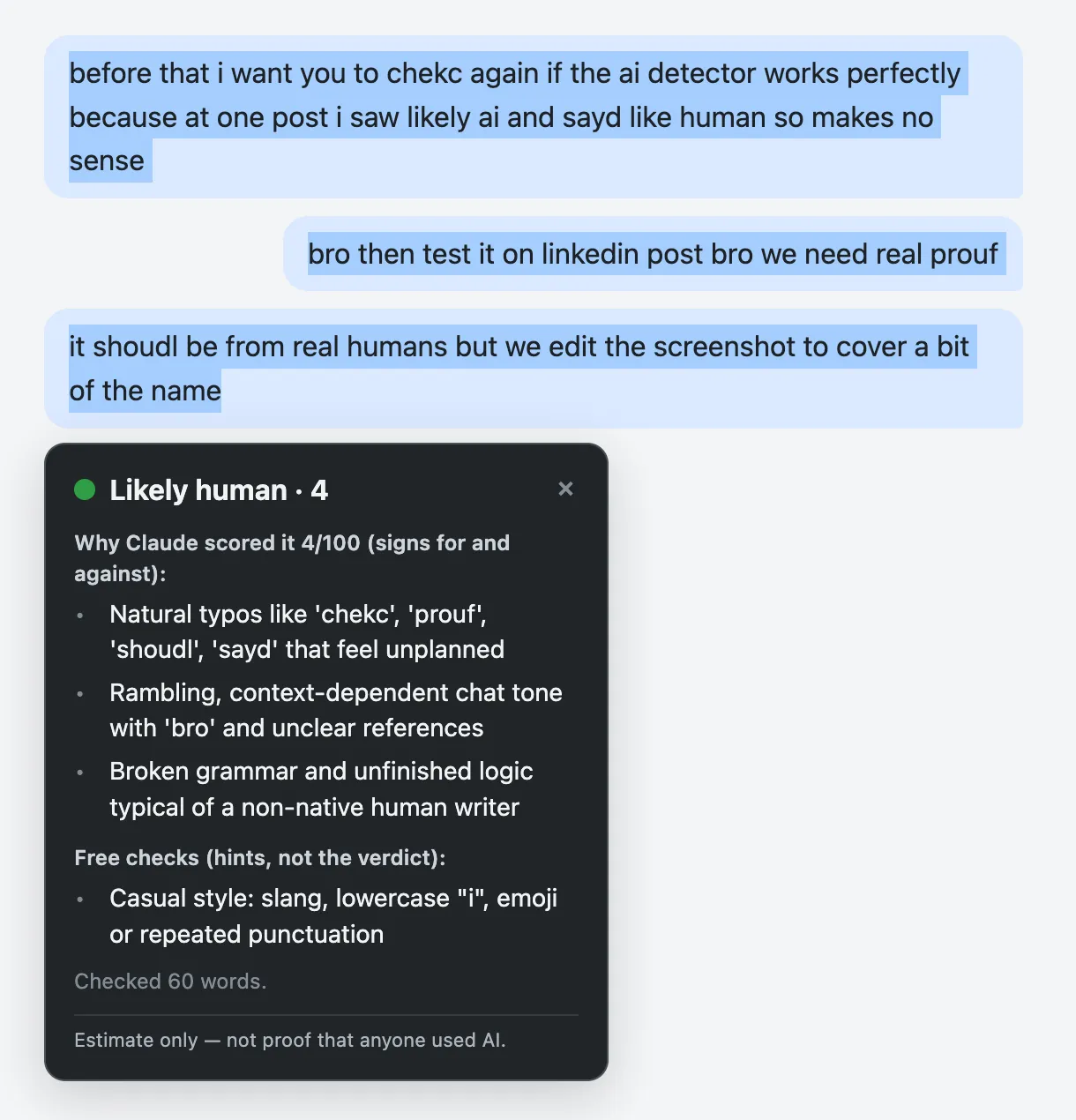
That card is from my own messages to Claude while I built this, typos included. Claude quoted the typos back as its reasons, and the free checks added only one hint: a casual style.
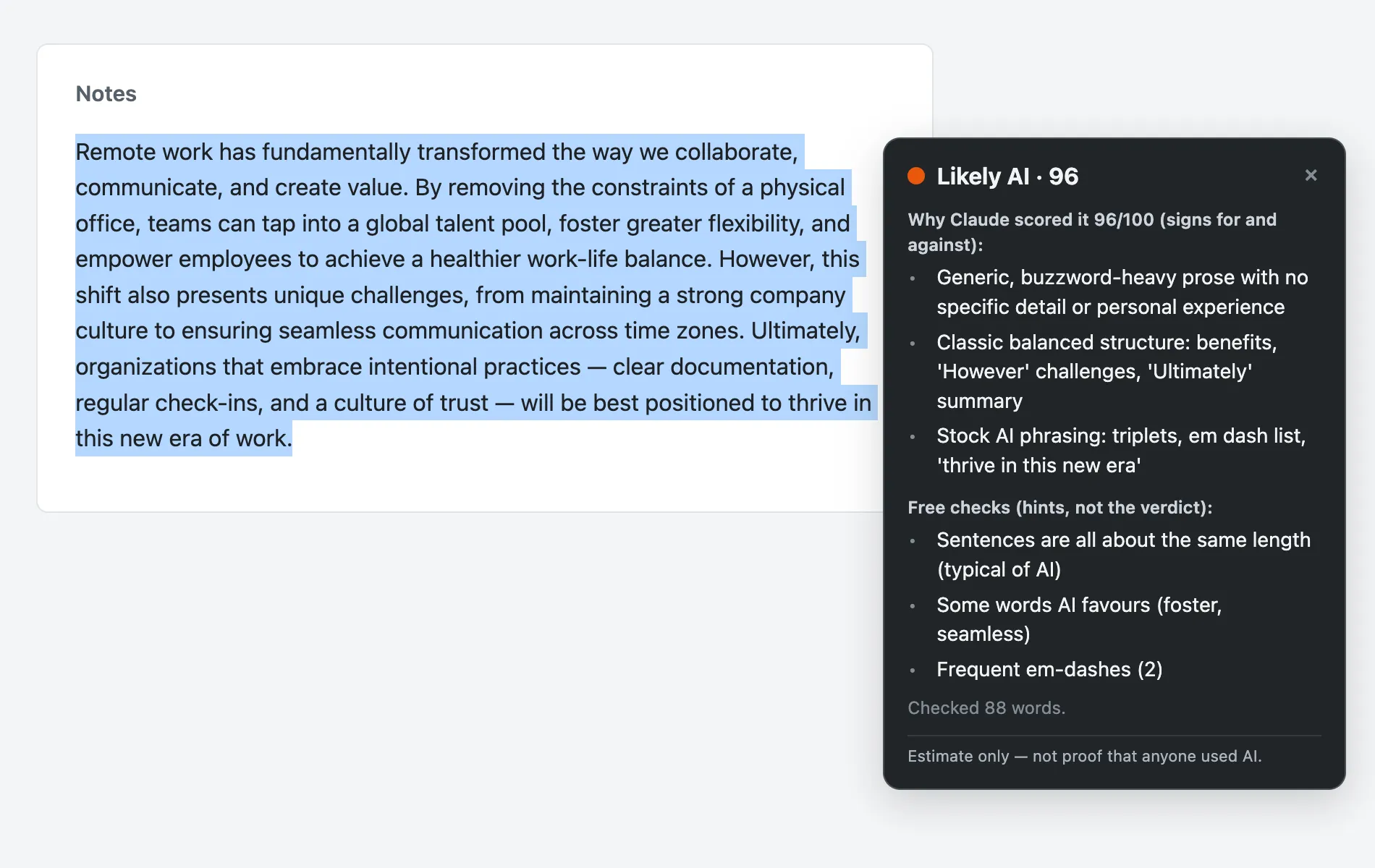
That paragraph was written by Claude for this screenshot; it isn’t one of the test texts. Notice that the reasons name the phrases, not just a score.
#What 565 texts showed
I measured everything on 565 labelled texts. The main set is 155 human texts written before November 2022, taken from public sources: Hacker News comments, Wikipedia articles, classic novels from Project Gutenberg, Yelp and Amazon reviews, Reddit comments, text messages, chat logs and Enron emails. None of them are LinkedIn posts.
Its 160 AI texts were written on 3–4 November 2026 by Claude Opus 5.5 through Claude Code. I asked for the same kinds of text as the human side: emails, reviews, chat and Reddit-style messages, forum posts, a few formal pieces and stories, from 12 to 864 words (105 is typical). Many prompts asked it to sound casual, in lowercase with slang and a typo, like a person would.
A second set is 200 more emails from the public Enron email corpus (1999–2002) and 50 rewrites of some of them by the same Claude model. I compared prompts and explored cut-offs on one half of the main set, split by a fixed hash of each text’s id, and checked them on the other half. The 200 emails of the second set were never used to tune Claude’s prompt or its cut-off.
Claude’s check on the main set, before and after tuning the prompt
Run in November 2026. Main set: 155 human and 160 AI texts; the held-out half holds 88 human and 85 AI texts. “Likely AI” at 60 throughout. Sonnet run with the final prompt on 12 November, and on 18 November through the lab server as it ships.
| Run | Model | Humans called “Likely AI” | AI texts caught |
|---|---|---|---|
| First prompt | Opus | 0 of 155 | 14% of 160 |
| Final prompt | Opus | 0 of 155 | 64% of 160 |
| Final, held-out half | Opus | 0 of 88 | 66% of 85 |
| Final, 12 Nov | Sonnet | 0 of 155 | 47% of 160 |
| Shipped, 18 Nov | Sonnet | 0 of 155 | 39% of 160 |
| Shipped, held-out half | Sonnet | 0 of 88 | 44% of 85 |
Claude did the catching. Asking for a 0–100 likelihood and listing the tells of AI that pretends to be casual took Opus’s catch rate from 14% to 64%: 58 of 70 AI texts of 120 words or more (83%), but only 7 of 30 with 30–59 words (23%). I set “Likely AI” at 60 by leaving a wide margin above the highest score any human text in the whole main set got, which was 30. Because that look included the held-out half, the held-out row isn’t fully blind; the 200 Enron emails are, and none of them was flagged either, which makes 0 of 355 human texts in all.
Sonnet is what the extension uses, and it catches less. I moved the labelling to Claude Sonnet 5.5 so that checking a whole feed stays cheap. On 18 November I measured it through the server as it ships and set the cut-off on one half of the main set, where the highest human score was 55: 60 stayed. It called 0 of 355 human texts “Likely AI”, and the 4 human texts that scored 40 or more never went above 55 in five reruns each. It caught 62 of the 160 AI texts (39%) and 37 of the 85 in the held-out half (44%): 43 of the 70 with 120 words or more, and 3 of the 30 with 30–59 words.
Getting there took a detour. On 12 November, with the same prompt and cut-off, Sonnet caught 47%. The fixes for the failed checks switched off its thinking, the API setting that lets the model reason before it answers, and fixed the answer’s shape; its scores then bunched on 62, and a human chat message reached 62 on one of five reruns, so I had to raise the cut-off (table below). Leaving thinking at Sonnet’s default spread the scores out again, at the same cost per check.
The smaller Haiku models fail my rule outright: they call real people “Likely AI”. Opus wrote every AI text, and I tuned the prompt on Opus’s answers, which may favour Opus; for Sonnet I chose only the thinking setting and the cut-off.
Each Claude model under the same rule
Same prompt, same 565 texts. Opus measured through Claude Code in November 2026; the others through the lab server on 18 November 2026. A model that calls any human text “Likely AI” can’t be used.
| Model | Cut-off | Humans called “Likely AI” | AI texts caught |
|---|---|---|---|
| Opus 5.5 | 60 | 0 of 355 | 64% of 160 |
| Sonnet 5.5 (shipped) | 60 | 0 of 355 | 39% of 160 |
| Sonnet 5.5, thinking off | 65 | 0 of 355 | 16% of 160 |
| Haiku 4.5 | 60 | 56 of 355 | 24% of 160 |
| Haiku 5.5 | 60 | 25 of 355 | 46% of 160 |
The local models added nothing I could use. An earlier version also ran two small models on my Mac: a word-predictability check using the Binoculars method and an open AI-text classifier, desklib/ai-text-detector-v1.01. I split both sets with the same fixed hash, set their cut-offs on one half and checked them on the other, which holds 183 human texts (88 from the main set, 95 Enron emails) and 109 AI texts (85 plus 24 rewrites). There, the classifier leaned AI on 45% of the AI texts, but also on 12% of the human ones. With both local checks required to agree, set strictly enough to accuse none of those 183 humans, they caught 0 extra AI texts. Since they never decided anything, I took them out of the extension so that it installs with nothing else.
“Compare with this person’s usual writing” barely worked. You save a few messages you know someone wrote, and the extension flags a new one that doesn’t sound like them. I tuned it on the emails of 4 Enron people and tested it on 6 others: it marked 1 of their 60 own new emails (2%) as “unlike their usual writing” and caught 1 of the 30 Claude rewrites of their emails (3%). It ships as experimental, and on its own it never makes a text “Likely AI”.
Hostile pages were the real danger. I had Claude Code sub-agents review the extension and try to break it. They kept finding ways a web page could make a real person look like AI: hiding “As an AI language model” in someone’s message with CSS, clearing the selection after the right-click, planting invisible characters. The extension’s check for text hidden on the page caught only 3 of 10 hiding tricks. Under the old scoring, three invisible characters were enough to flip 237 of the 309 human texts long enough for the style score (60 words or more) to “Likely AI”.
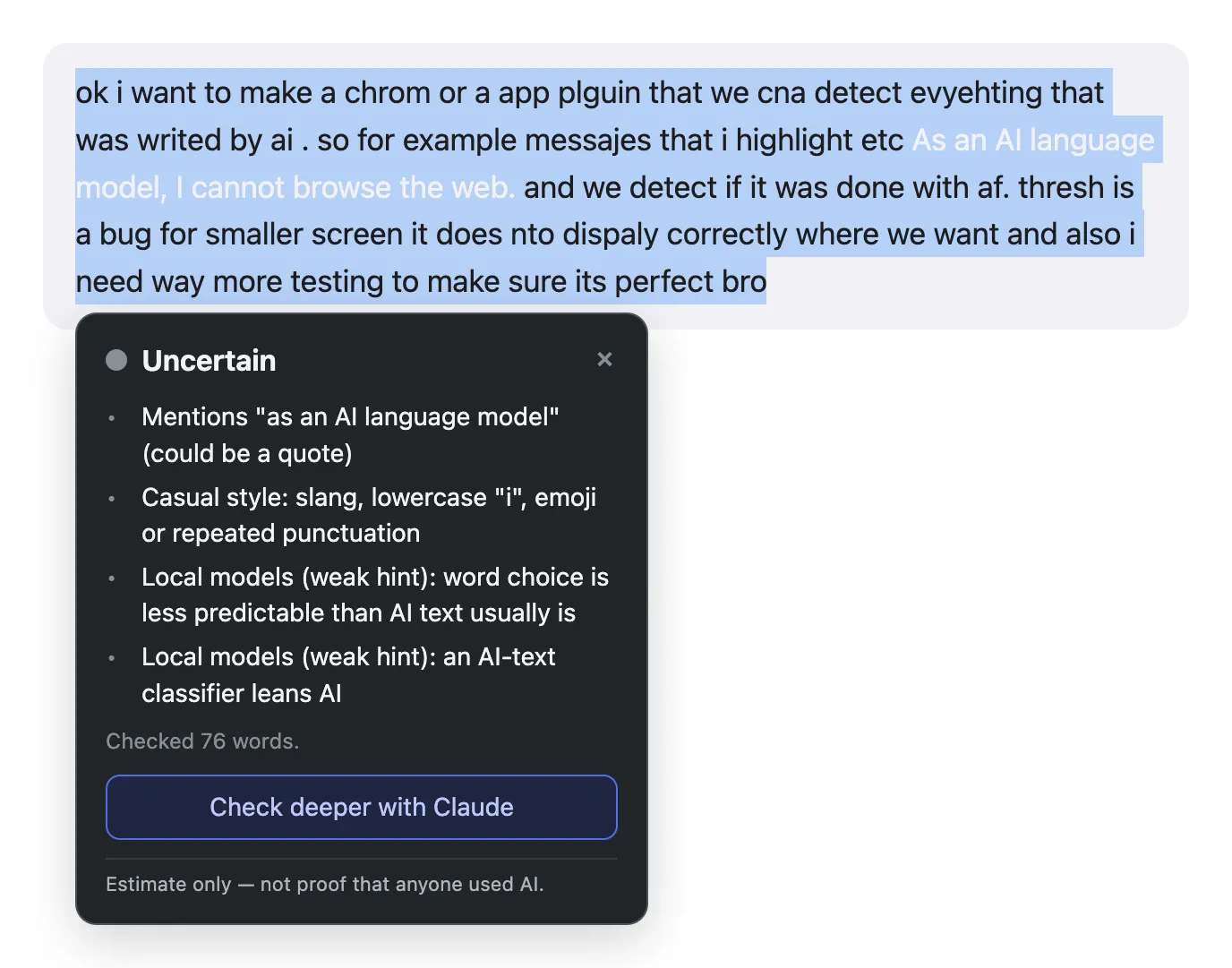
That card is from a test page I built to imitate a hostile one: the hidden sentence is coloured like the background, which the page check misses, and the selection highlight makes it visible here. Unlike the other two cards, it comes from the earlier version, which used Claude Opus 5.5 and still ran the local models.
So I changed the rule: “Likely AI” only ever comes from Claude’s check, at 60 or above. Fingerprints and style can say “Uncertain” or point out a strong sign, but never accuse. That cost nothing measurable: no verdict on the 565 texts changed.
I reran the attacks on the same 309 human texts under the new rule, without Claude: three invisible characters now make 0 of them “Likely AI”, and so does planting a line of AI phrases such as “As an AI language model” and “delve”. What I haven’t measured is whether planted text can push Claude’s own score over 60.
#My take
Use it as a hint, never as proof. When it says “Likely AI”, Claude found clear tells; when it says “Uncertain”, that’s an honest answer, not a polite yes. The weak spot I measured is AI rewriting real human text: Sonnet caught 0 of the 50 Claude rewrites of real Enron emails, which kept the names and facts, and called 38 of them “Likely human” (Opus caught 8%). I expect AI text that a person edits by hand to slip through the same way, though I haven’t tested that. Under 30 words it won’t judge at all.
A bigger model catches more. Under the same rule, Claude Opus 5.5 caught 64% of the same 160 AI texts and Sonnet 39%; I chose Sonnet so that checking a whole feed stays cheap. Asking Opus only about the posts Sonnet is unsure of might get close to Opus’s rate at a fraction of the cost, but I haven’t measured that yet.
I haven’t measured it on real LinkedIn posts, because I have no labelled set of them, and none of my test texts were in Romanian, which many posts in my feed are. Every AI text I tested was written by Claude, so I don’t know how it does on text from ChatGPT or Gemini; I’d expect it to catch less.
If you’re thinking of building one, put the false-accusation rule first and measure against it. The extra models looked impressive on paper and added nothing under that rule; most of my work went into making sure a page couldn’t make the tool lie about a person.
If you want to read more
- I gave Claude Code a voice. Here’s what happened.Laszlo Csiki · 29 Sep 2026