
TL;DR
- The question: can Claude Code build a multiplayer browser game for someone who doesn’t know the web stack?
- The result: a playable game, public seven days after the first commit, with 2,421 automated tests.
- My part was deciding. Claude Code did the building, mostly overnight.
- Play it at tanks.x2labs.ai.
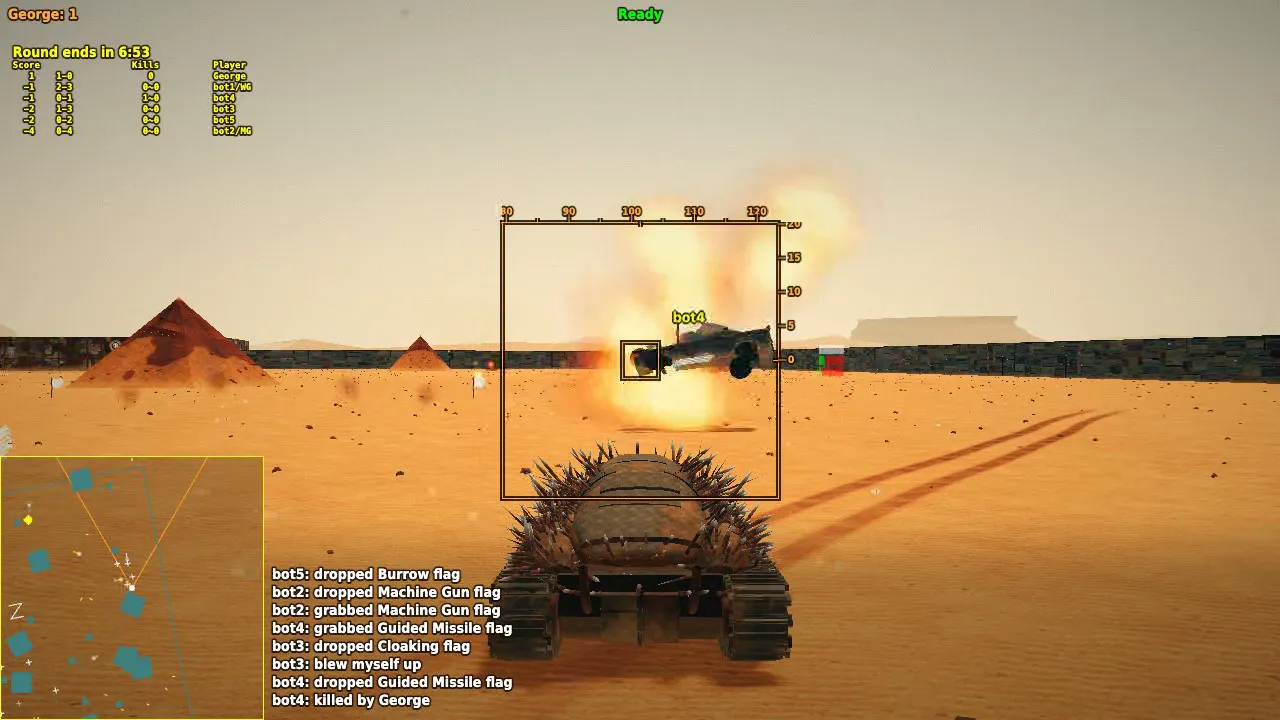
Play it at tanks.x2labs.ai → No install, no account. The screenshot is from a local game against bots.
In high school, around 2008, my friends and I played BZFlag on LAN. Tanks in a big arena, everyone shooting everyone, flags with powers all over the map. It was great fun, and I wanted it back: not on a LAN, but behind a link anyone can open.
I don’t know much about the web stack. TypeScript, three.js, WebSockets, Docker were tools that I had no experience with. So the question was simple: how far can Claude Code take someone who knows what he wants but not how to build it, if I refine the plans during the day and let it work through the night?
#From a memory to a design
I started by telling Claude Code what I remembered: the free-for-all mode, no teams, tanks that come back after they’re destroyed, flags that appear around the arena now and then. It asked me the questions only I could answer and wrote them into a design, with every decision I made marked as mine.
Three rules from that design shaped everything after it:
- The same game. Same rules, numbers, physics and flags as BZFlag 2.4.30. Where my design says nothing, BZFlag’s own source code decides.
- In the browser, from anywhere. Open a link, type a name, play. No install, no account.
- No lag. My one hard requirement. When better graphics and a steady frame rate disagree, the frame rate wins.
#Plans by day, building by night
Each design became one or more plans of around 20 tasks, each task small enough to build and test on its own. Claude Code then worked through the plan task by task. For most tasks a helper agent built it, and a second one reviewed it before the next task started.
The main session ran Claude Code on Opus 5.5 at high effort, from 21 to 28 October 2026. It planned, reviewed and made the calls the plans didn’t cover. The helper agents that wrote and reviewed most of the tasks ran mostly on Sonnet 5.5.
My days looked like this:
- In the morning, look at what was built overnight and read what Claude Code had decided.
- During the day, refine the next plan and answer its questions.
- In the evening, start the plan and let it run.
The commit history shows the rhythm. 167 of the 210 commits landed between 6 p.m. and 8 a.m. Romanian time, and 68 of those between midnight and 8 a.m.
#What it built
A recording from a local game against bots, not live players.
In seven days it went through six plans: the basic game, a round of follow-ups, combat, flags, a new desert look, and going public. The desert look is the project’s own: Claude Code wrote the code that generates every texture and sound, and the cars are built from code in the browser.
Seven days of Claude Code
Counted from the git history, the plans and the test runner on 28 October 2026. Good flags give you a power; bad ones you have to shake off.
| What | Number |
|---|---|
| Days from first commit to public | 7 |
| Designs I approved | 3 |
| Plans | 6, with 106 tasks |
| Commits | 210, all co-authored by Claude |
| Game code | about 43,000 lines of TypeScript |
| Test code | about 27,000 lines |
| Automated tests | 2,421, plus 7 browser test files |
| Files ported from BZFlag’s C++ | 55 |
| Flags | 40: 27 good, 13 bad |
| Settings | 182: BZFlag’s 167, plus 15 new |
I would never write 2,421 tests myself. Claude Code wrote them with every task, and every task had to pass them before it was kept. I think that is why I could let it work overnight.
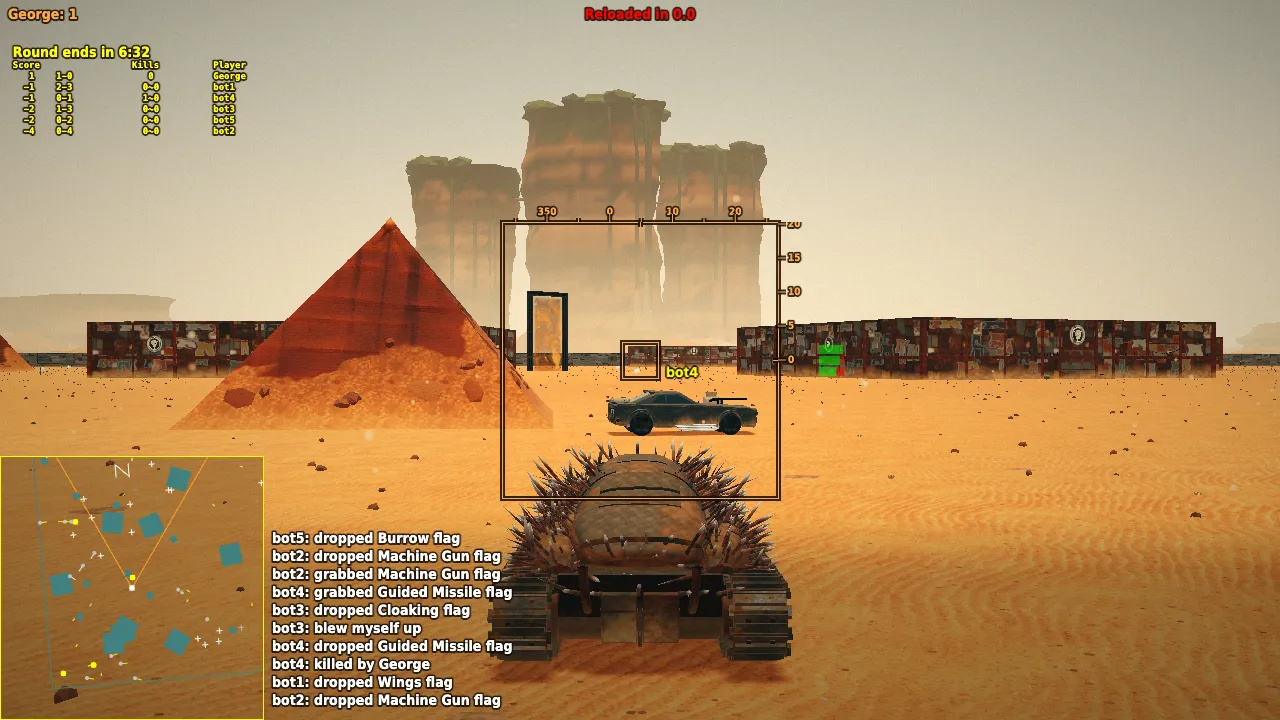
The view from outside the car, in a local game against bots.
Going public was its own plan of 20 tasks. The game now has a lobby of arenas of up to 10 players, arenas you can create with a password for your friends, 10-minute rounds, and a bad-word filter in English and Romanian. It also has a stats page for me, and it sends me a Slack message when it needs me.
#Where to play
The game is at tanks.x2labs.ai. It runs in a desktop browser.
- Type a name and pick an arena, or create your own with a password and send it to your friends.
- Drive with the arrow keys or WASD and fire with Enter or a mouse click. Tab jumps, and V switches between the view from inside and from outside.
- Drive over a flag to pick it up. Some help you, some don’t.
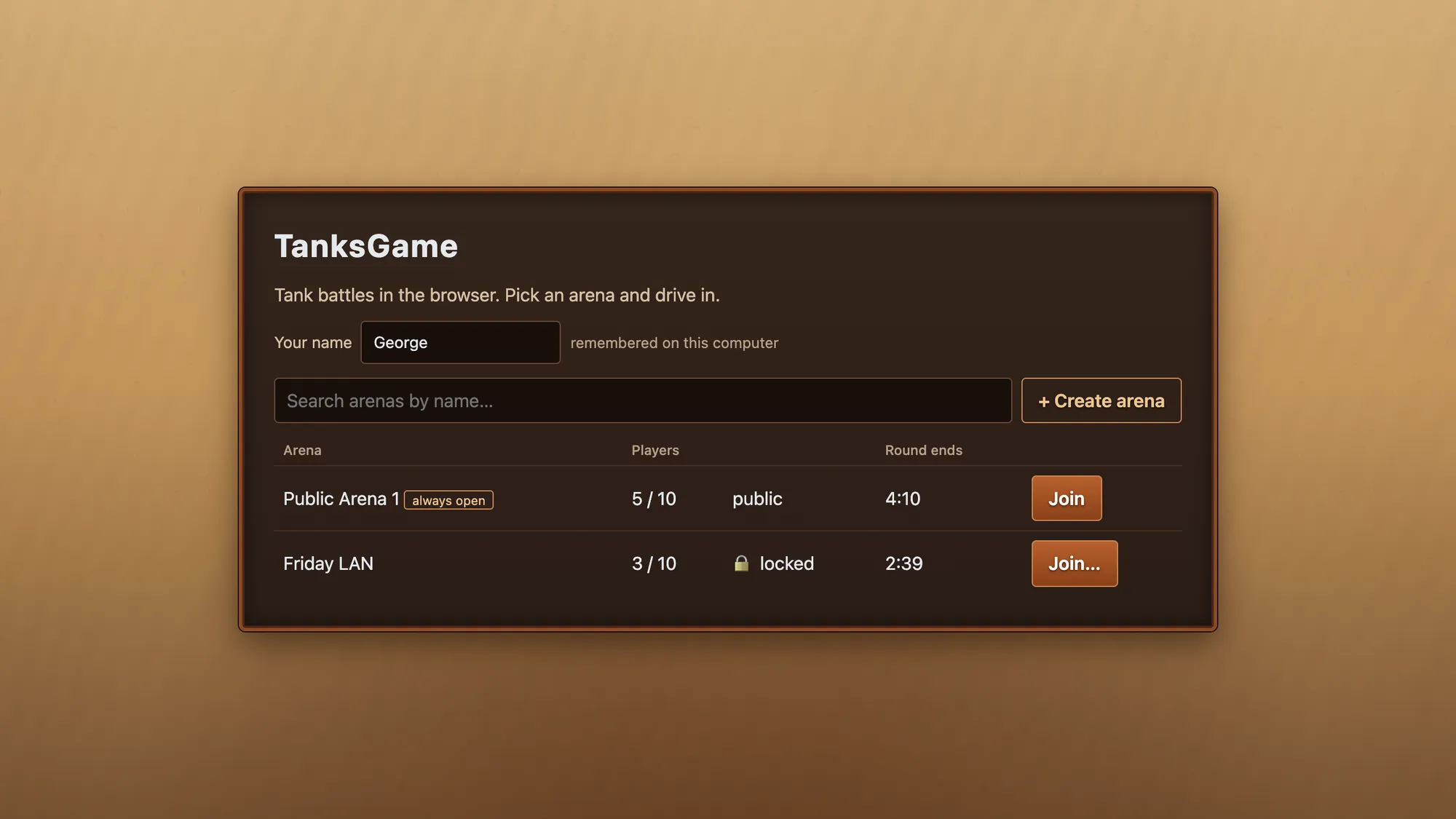
The lobby, with a public arena and a private one, from the same local test.
#My take
I’d do it again. What surprised me most was how easy it was. I spent my time on the part I know: what the game should be and how it should feel. Claude Code took the part I don’t know, the web stack, and turned it into a working game in a week.
The work doesn’t disappear, though. You still read the plans and answer the questions. If you can’t say clearly what you want, Claude Code can’t build it for you.
If you have a clear picture of something and no time to learn the stack behind it, try this way of working: decide during the day, let it build at night. And if you played BZFlag on a LAN once, come and play it again.
BZFlag is by Tim Riker and the BZFlag team, under the Mozilla Public License 2.0: github.com/BZFlag-Dev/bzflag. The game draws its 3D with three.js.